
What It Means to Become a Validator’s Answer Instead of an Explorer’s Option
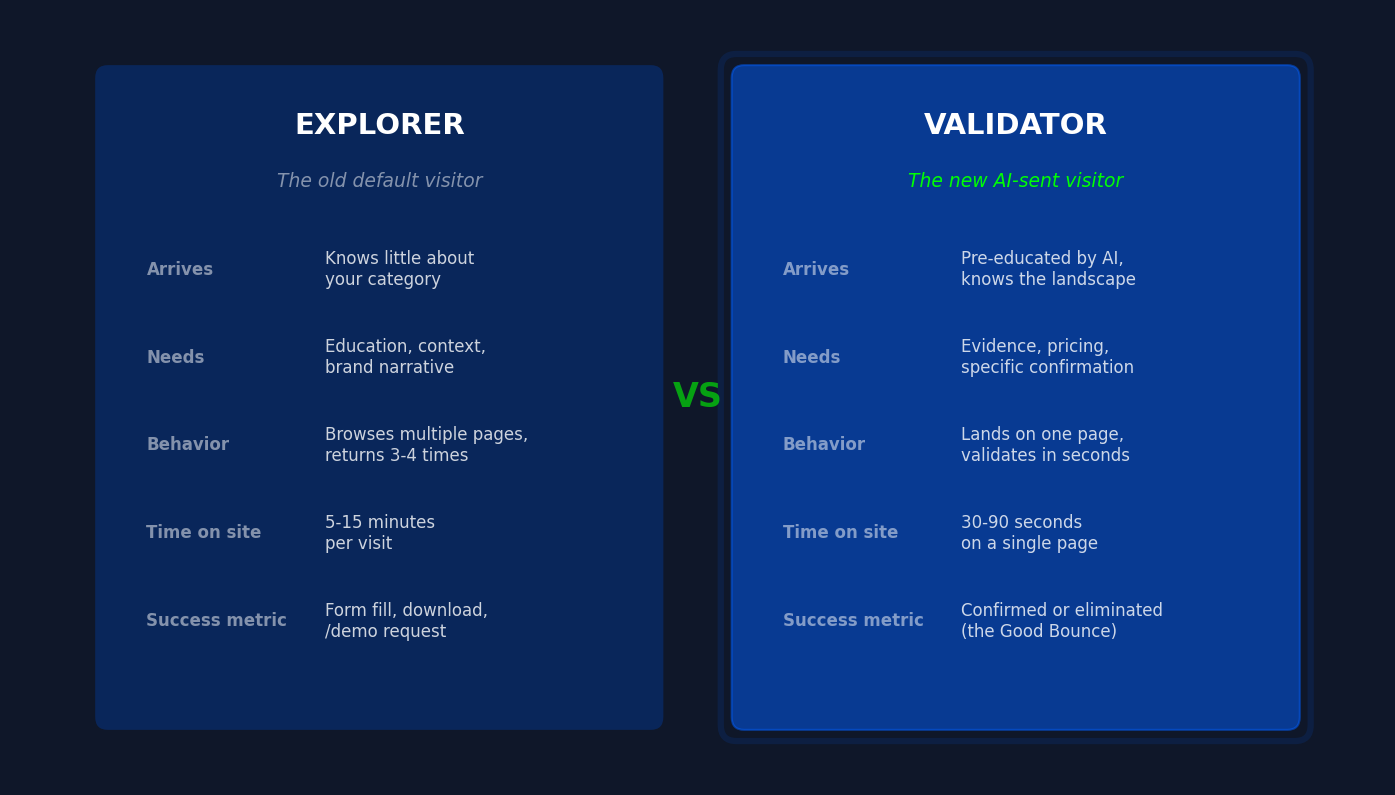
For twenty years, most B2B websites had one job: educate someone who showed up knowing very little. The visitor browsed. They read category explanations. They compared features across tabs. They came back three times before requesting a demo. The entire marketing funnel was built around this person. We called them the Explorer.
AI changed the default visitor.
Validators Scan for Specific Facts, Not Narratives
Validators do not arrive at your website to learn what your category is. They already know. They spent fifteen minutes asking ChatGPT about it. They got a thorough explanation of the landscape, the key players, the tradeoffs between approaches, and a short list of companies that fit their requirements.
When a Validator lands on your site, they are looking for three things: confirmation that you do what the AI said you do, evidence that you have done it successfully for companies like theirs, and a clear path to evaluate or buy. That is it.
They are not reading your About page. They are not watching your brand video. They are not downloading your whitepaper to learn about industry trends. They are scanning for specific, verifiable facts. Can you handle their use case? What does it cost? How long does implementation take? Who else has done this?
If they cannot find those answers quickly, they leave. Not because your site is bad. Because it was not built for them. It was built for Explorers who needed handholding. Validators do not need handholding. They need confirmation.
Explorer Brochures Deflect Validators
The standard B2B website is an Explorer brochure. It starts with a hero section that makes a vague claim about transformation. Then a section with three pillars of value, each described in marketing language. Then a logo bar. Then a testimonial carousel with generic quotes. Then a call to action to “learn more” or “get started.”
For an Explorer, this is fine. They need context. They need to be educated. The narrative builds understanding and trust over multiple visits.
For a Validator, this is friction. They know what “transformation” means in your category. They do not need you to explain it. They need to know if your specific implementation handles their specific requirement. When they see vague claims instead of specific evidence, they lose confidence. When they see “learn more” instead of “see pricing” or “view documentation,” they lose patience.
The worst version of this is the gated asset. A Validator wants a technical spec or a pricing breakdown. Your site offers a case study PDF in exchange for their email. The Validator recognizes the trade: give us your contact info and we will let you see the information you need to evaluate us. That is not confirmation. That is a toll booth.
Every element designed to capture and nurture an Explorer is an obstacle for a Validator. The two visitor types need opposite things. Explorers need education. Validators need evidence.
Becoming a Validator’s Answer Requires Different Architecture
The shift from Explorer brochure to Validator confirmation engine is not cosmetic. It is architectural. It requires restructuring how information is organized, presented, and made accessible to both humans and machines.
This is what we call Answer Architecture. It has three gates.
Extraction. Can an AI system read and extract your claims? This is the Clarity layer. If your content is buried in PDFs, trapped behind forms, or written in language too vague for a machine to parse, the AI cannot extract it. It cannot represent you accurately in answers because it cannot understand what you are claiming. Extraction requires structured, specific, machine-readable content. Claim + evidence + context.
Correlation. Can the AI match your claims to the buyer’s question? This is the Coverage layer. You might have clear content about your capabilities, but if it does not align with the topics buyers are actually asking about, the AI will not surface you. Coverage requires understanding the questions your buyers ask in AI tools and ensuring your content addresses those questions directly.
Synthesis. When the AI combines your claims with information from other sources, does the result help or hurt you? This is where evidence strength matters. If the AI finds your claims but cannot corroborate them with third-party data, customer references, or verifiable outcomes, it may cite you but hedge. “Company X claims to reduce costs by 30%.” That is a citation with doubt built in. Strong evidence turns that into “Company X reduced costs by 30% for [specific client type], according to [source].”
Your website needs to pass all three gates to become a Validator’s answer. Most B2B sites fail at Extraction because their content is vague. Many that pass Extraction fail at Correlation because they talk about themselves in ways that do not map to buyer questions. And most that pass both fail at Synthesis because their claims lack verifiable evidence.
The Companies That Win Will Be Confirmation Engines
The shift from Explorer world to Validator world changes what winning looks like. In the Explorer era, the winner was the company with the best narrative. The most compelling brand story. The most polished website. The most downloads.
In the Validator era, the winner is the company that confirms fastest. When a buyer asks an AI who to consider, your company needs to be in the answer. When that buyer clicks through to your site, they need to find exactly what the AI promised, plus the evidence to back it up. No surprises. No friction. No vague claims that require a sales call to decode.
This is what a confirmation engine does. It validates the AI’s recommendation by giving the Validator exactly what they came for. Specific claims. Verifiable evidence. Clear next steps. Fast.
The companies building confirmation engines right now are compounding their advantage. Every Validator who has a good experience on their site becomes a data point. The AI learns that this company’s claims are accurate, their evidence is strong, and visitors who click through tend to engage and convert. The AI recommends them more often, with more confidence. More Validators arrive. More confirm. The loop accelerates.
The companies still building Explorer brochures are compounding too, but in the wrong direction. The AI learns that their content is vague, their claims are unsubstantiated, and visitors leave quickly. The AI recommends them less often, or recommends them with hedging language. Fewer Validators arrive. The ones who do find nothing to confirm. The loop decelerates.
You do not need to abandon Explorers. But you need to serve Validators first, because that is who AI sends you. The Explorer funnel still works for people who find you through other channels. The Validator funnel is where the growth is coming from now, and it compounds.



Find Out What AI Tells Buyers About You
An AI visits your site and reports everything it found. Scored across six categories with machine-verifiable findings. No cost, no pitch.
Get Your Free Snapshot