
Your traffic looks fine. Your rankings are stable. Your content calendar is full. And somewhere between the AI answer and your website, a buyer made a decision about your company without ever showing up in your analytics.
That’s the conversion collapse. It isn’t a traffic problem. It’s a measurement problem. And almost nobody is measuring it.
What the Data Is Actually Saying
Two things happened last week that should make every B2B marketing leader stop and recalculate.
First, Microsoft put a slide in a webinar that said, plainly: “AI summarizes results, reducing clicks and website visits.” This came from a senior product marketing manager, not an engineer going off-script. Microsoft operates the second-largest search engine on the planet, and they’re acknowledging that AI search cannibalizes the click path your entire analytics stack is built on.
Second, Google rolled out AI performance reports in Search Console. They show impressions. They show which pages appeared in AI Overviews and AI Mode. They don’t show clicks. Google gave us visibility without outcome. You can see that your content showed up. You can’t see whether it mattered.
Put those together. One search engine admits AI reduces website visits. The other gives you a report that tracks impressions but deliberately omits what happened next. This isn’t a coincidence. It’s the architecture of a measurement gap.
Why Your Analytics Miss It
Most B2B companies track conversion from the first pageview. A visitor lands on the site, clicks through a few pages, fills out a form or requests a demo, and the CRM logs a lead. The whole funnel starts at the first click.
But AI-referred traffic doesn’t work that way. A buyer asks ChatGPT for ERP recommendations, gets a specific answer with three or four vendors named, and arrives at your site already knowing what they want to validate. They don’t browse. They don’t explore. They land on one page, confirm or deny what AI told them, and leave.
Your analytics counts that as a bounce. A failure. In reality, it’s either a successful validation (they confirmed AI’s recommendation and moved on to the next stage of their evaluation) or a failed one (they saw something that contradicted what the AI said and dropped you). You can’t tell the difference because your analytics doesn’t know they came from AI, doesn’t know what AI told them, and doesn’t track what happens after they leave.
This is what your bounce rate is actually hiding. Some of your highest-value visitors are the ones who bounce fastest, because they arrived with intent already formed and either found confirmation or didn’t.
The Measurement Gap in Three Parts
The conversion collapse has three layers, and most companies have zero visibility into any of them.
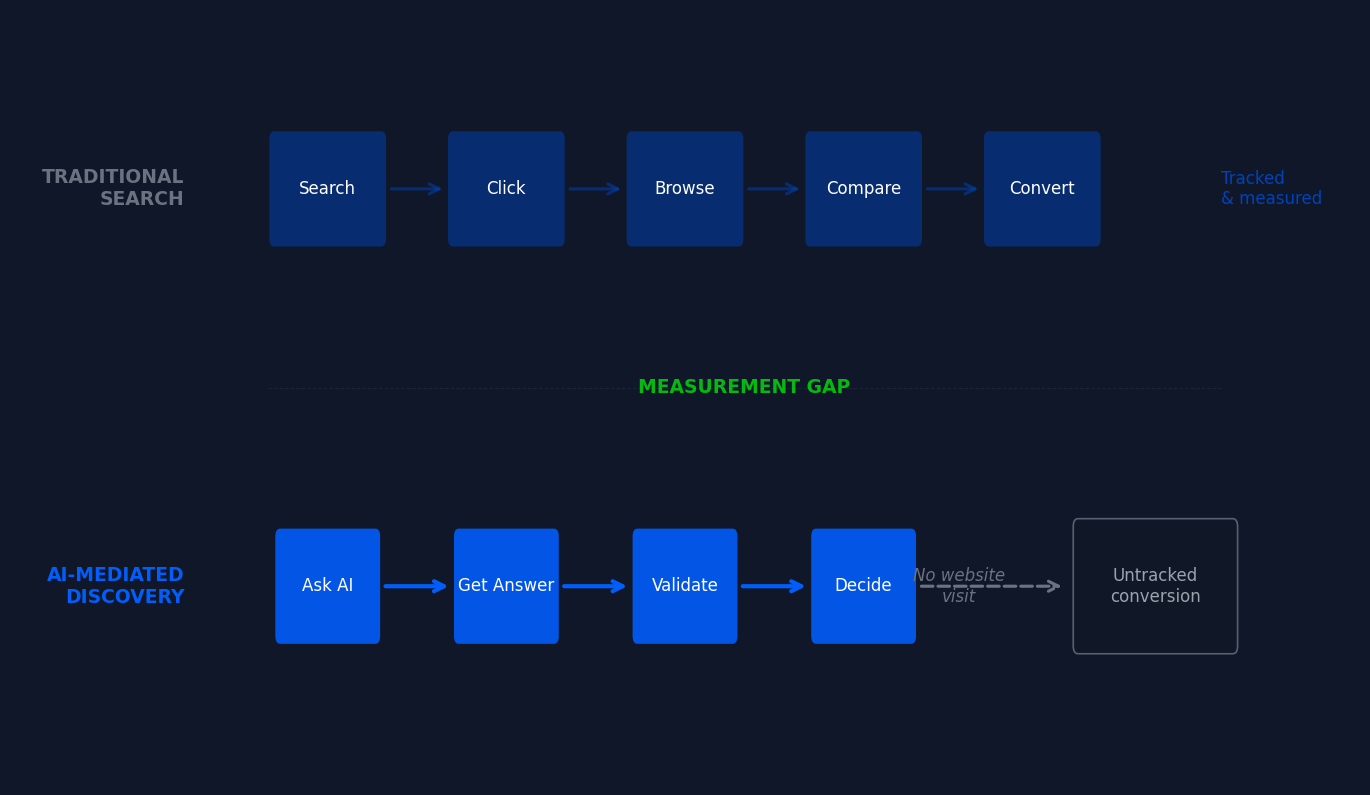
Layer one: you don’t know who AI sends you. Google’s AI reports show impressions, not visits. ChatGPT, Claude, and Perplexity don’t send referrer data you can filter by. Your analytics sees “direct traffic” or “organic search” and has no idea the visitor started with an AI recommendation.
Layer two: you don’t know what they came to confirm. AI-sent visitors arrive as Validators, not Explorers. They have a specific question, formed by the AI’s answer, and they’re on your site to check one thing. If your page answers that question immediately, they leave satisfied. If it doesn’t, they leave confused. Either way, it’s one pageview and out.
Layer three: you don’t know what happens next. Did the buyer add you to their shortlist? Did they ask the AI for more information about you? Did they move on to a competitor? You don’t have data on any of this because your funnel assumes the next step happens on your website. In an AI-mediated buying process, the next step often happens back in the AI.
What This Looks Like in Practice
We ran a diagnostic on a mid-market industrial manufacturer. Their Clarity Index score was 22 out of 100. They ranked page one for 14 target keywords. Traffic was steady. Conversions were flat, and had been for two quarters.
The problem wasn’t traffic. It was that AI models couldn’t extract consistent, specific information about the company. When buyers asked AI about solutions in this company’s category, the models either excluded them entirely or described them incorrectly. The company was losing deals before the buyer ever reached their site.
Their analytics showed the same traffic numbers month over month. What it didn’t show was the growing pool of buyers who asked AI for a recommendation, never saw this company’s name, and went to a competitor instead. That’s a conversion collapse that looks like a flat line.
Microsoft’s Slide Is the Signal
When Microsoft says AI reduces clicks and website visits, they’re describing the mechanism. When Google gives you impressions without clicks, they’re describing the measurement gap. Together, they’re describing a world where your most important conversion data is invisible to your current tools.
This isn’t a prediction about where things are headed. It’s happening right now. Buyers are making decisions about your company inside AI systems. Some of those decisions result in a visit to your site. Many don’t. And the ones that don’t are the fastest-growing segment of your pipeline that you can’t see.
The fix starts with measuring what actually matters: whether AI systems can extract a clear, confident answer from your presence, whether that answer is accurate, and whether the visitors who do arrive from AI find what they came to confirm.
Your competitors are showing up in answer sets that are hardening around a few names. The ones that earn a spot now are building a compounding advantage. The rest are losing deals they’ll never know they lost, because the measurement gap swallows the evidence.
If you can’t measure the conversion collapse, you can’t fix it. And if you’re still optimizing for pageviews and bounce rates, you’re optimizing for the wrong thing.



Find Out What AI Tells Buyers About You
An AI visits your site and reports everything it found. Scored across six categories with machine-verifiable findings. No cost, no pitch.
Get Your Free Snapshot