
Answer Sets Are Hardening: Why First Movers Win the Decade
Ask ChatGPT to recommend ERP providers for mid-market manufacturing. Then ask Gemini. Then ask Claude.
You’ll get different answers, but the overlap is the part that matters. A handful of names show up across all three. That overlap isn’t random. It’s the beginning of something that will shape how buyers find vendors for the next decade: the hardening of AI answer sets.
What an Answer Set Actually Is
When a buyer asks an AI for a recommendation, the model doesn’t search the web the way Google does. It synthesizes an answer from training data, retrieval-augmented context, and the confidence patterns embedded in its weights. The resulting list, usually three to seven names, is an answer set.
Answer sets aren’t static. They shift as models retrain, as new information surfaces, and as query phrasing changes. But they’re becoming more stable, not less. Here’s why.
The Hardening Mechanism
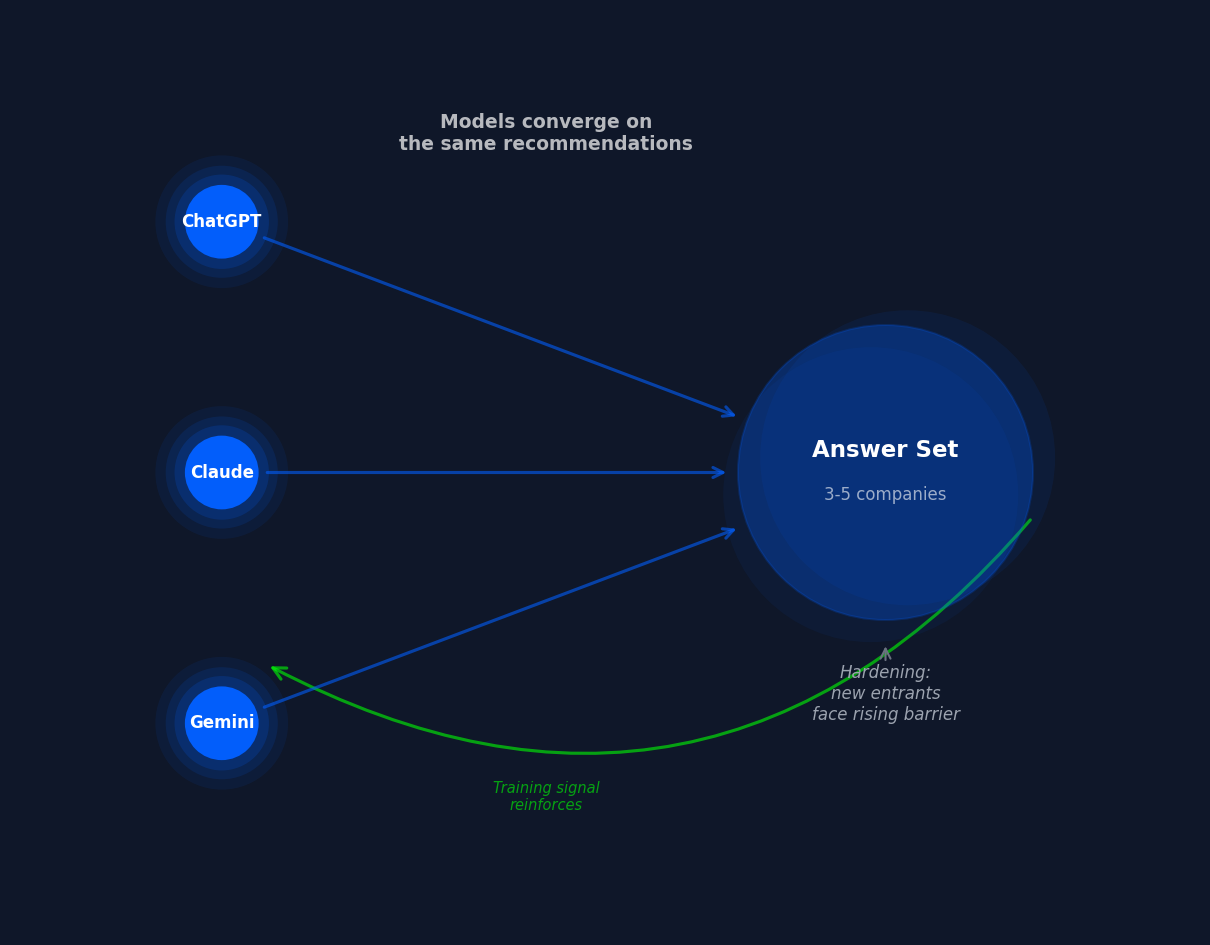
AI models are converging. Research on large language model behavior shows that leading models, despite different architectures and training datasets, are producing increasingly similar outputs on the same queries. The “Great LLM Convergence” is a documented trend: reasoning patterns, judgment frameworks, and even specific recommendations are aligning across platforms.
This convergence has a compounding effect on answer sets. When multiple models independently recommend the same brands for the same category, those brands accumulate what amounts to cross-model validation. Each recommendation reinforces the training signal. The models learn: these are the names that show up in authoritative sources. These are the companies that get cited. These are the answers that users accept.
The companies that appear in answer sets today are teaching every major model to include them tomorrow.
Why Getting In Early Matters More Than Getting In Often
In traditional search, you always had a path to a better position. New content, better backlinks, refreshed keywords. The barrier was effort, not architecture.
AI answer sets work differently. A model’s recommendation isn’t a ranking you earn with a single strong page. It’s an entity-level judgment. The model has to recognize your company as a distinct, authoritative entity with consistent, specific, current information spread across multiple sources it trusts.
Once that recognition is established, it’s self-reinforcing. The model recommends you. Users see the recommendation. Third-party content references you in that context. The model encounters that content in future training. The loop compounds.
Once it isn’t established, the opposite happens. The model doesn’t recommend you. No third-party content mentions you in that context. There’s nothing for future training to reinforce. The gap widens.
This is why “we’ll get to it next quarter” isn’t a neutral decision. Every month you’re not in the answer set, the set is hardening without you.
What We Are Seeing in Practice
We run AI readiness diagnostics for B2B companies. The pattern is consistent and sobering.
A manufacturing client appeared in 0 of 47 buyer-sourced queries across five AI platforms. Zero. Their competitors appeared in 38 of those same queries. That isn’t a ranking gap. That’s a presence gap. The models didn’t rank the client poorly. They didn’t consider the client at all.
Another client appeared in none of the category queries we tested. The AI systems consistently recommended competitors by name, often the same three brands, across every platform.
These companies have decent websites. They have content. They rank for their brand terms in traditional search. But AI models aren’t finding them because their information isn’t structured for extraction, isn’t consistent across sources, and isn’t specific enough to be cited with confidence.
They are on the wrong side of a closing window. And the window is closing across six AI surfaces now, not just the five you can probe through a browser.
The Three-Layer Reality
Getting into answer sets isn’t one thing. It requires progress on three layers, and they build on each other.
Clarity comes first. Your information has to be accurate, consistent, specific, and current enough that AI can extract it and trust it. This is the Clarity Index: accuracy, consistency, specificity, recency, and context. If your Clarity is weak, AI will hedge, and hedging means exclusion.
Coverage follows. Once your information is clear, you need to be present across the sources AI models actually draw from. Not just your website. Industry publications, directories, review platforms, and the broader web graph where models cross-reference claims.
Conversion completes the system. When AI-referred visitors arrive, they’re already pre-educated. They’re Validators, not Explorers. Your site has to confirm what they already know, not start from scratch.
Most companies trying to “show up in AI” start at the wrong layer. They chase Coverage tactics without fixing Clarity first. That’s like trying to get press coverage with a broken pitch.
What First Movers Are Actually Doing
The companies showing up in answer sets consistently aren’t doing anything mysterious. They’re doing specific things well:
- Making their product and service data machine-readable (structured data, consistent naming, structured specs)
- Ensuring their information matches across their website, Google Business Profile, industry directories, and third-party sources
- Publishing specific, current content that answers the exact questions buyers ask AI systems
- Maintaining recency. Press releases from 2023 don’t count as current in a model trained on 2026 data
None of this requires a massive budget. It requires specificity and consistency, which are execution problems, not resource problems.
The Clock Started Before You Knew It Was Running
The hardening of answer sets isn’t a prediction. It’s an observable pattern in how AI models are behaving right now. The 4.3% of B2B companies that currently show up consistently in AI buyer queries are building a compounding advantage with every interaction they earn.
The rest are falling behind in a way that gets harder to fix every month, because every month the models train on data that doesn’t include them.
This isn’t about SEO. It’s not about content marketing. It’s about whether your company exists in the information layer that’s becoming the primary interface between buyers and vendors.
If AI can’t extract a clear, confident answer from your presence, it’s building one from someone else.




Find Out What AI Tells Buyers About You
An AI visits your site and reports everything it found. Scored across six categories with machine-verifiable findings. No cost, no pitch.
Get Your Free Snapshot